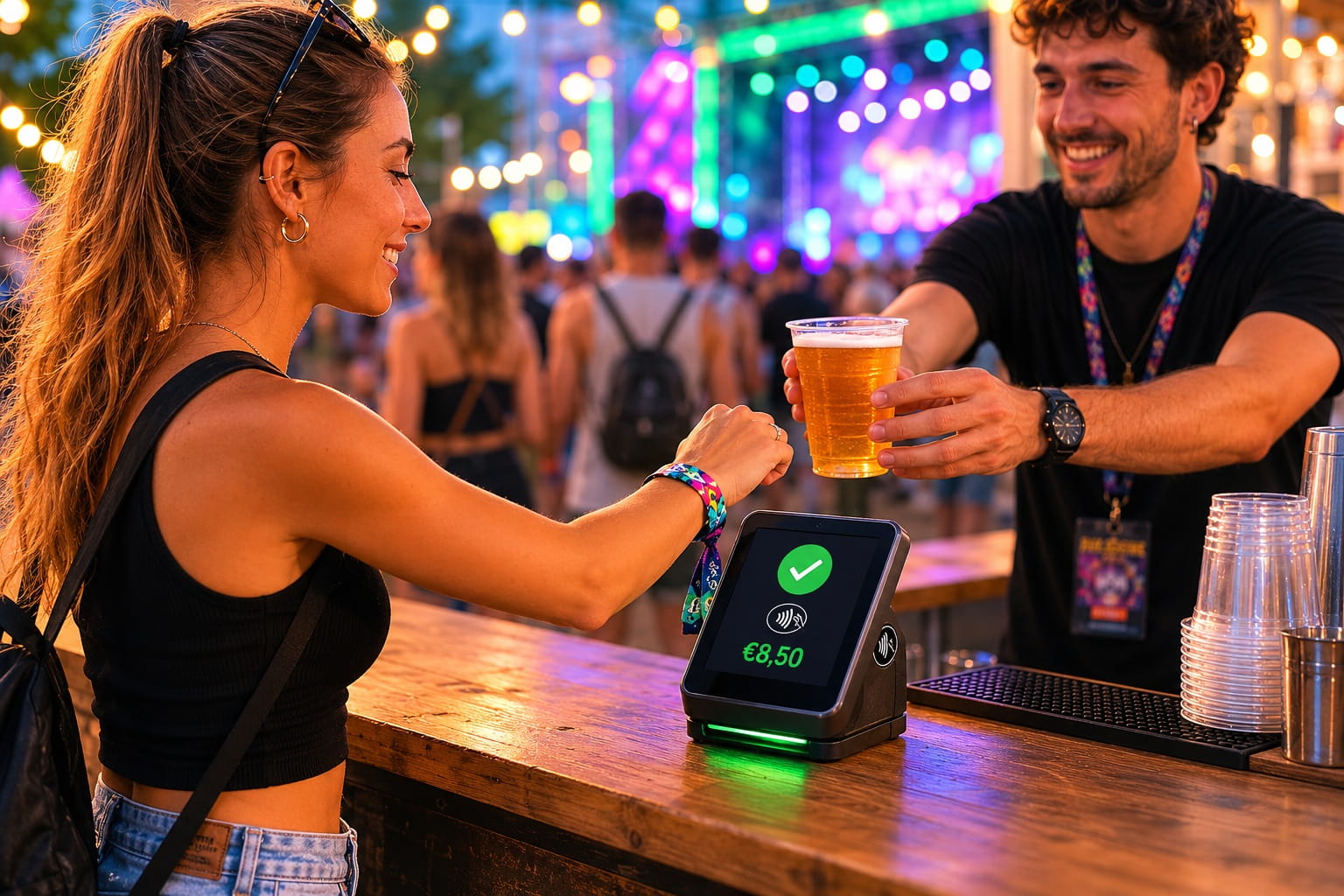
Cashless is a payment system that allows event attendees to pay at bars, food trucks, and stands using a wristband, card, or sticker with RFID or NFC technology.
Instead of carrying cash, attendees load funds onto their device before or during the event and pay with a simple tap at any point of sale within the venue. This requires a cashless payment system for events that supports this payment method. A cashless payment system for events therefore covers everything from the wristband the attendee wears to the software the organizer uses to monitor sales in real time.
Cashless literally means “without cash.” In the context of events and festivals, it refers to any digital payment system that eliminates the use of coins and banknotes within the venue.
The term became popular in the music festival sector starting in 2010 and is now the standard at major events throughout Europe.
The cashless wristband is the most widely used format at festivals and concerts. It has an integrated RFID or NFC chip that stores the attendee’s balance and communicates with the venue’s payment terminals.
The process is simple:
The system works offline, so there are no payment interruptions even if the signal fails.
Although often used interchangeably, RFID and NFC are two different technologies:
RFID (Radio Frequency Identification) — identifies the chip remotely using radio waves. It is the most widespread technology in festival wristbands due to its low cost and reliability.
NFC (Near Field Communication) — is a variant of RFID that requires a maximum proximity of a few centimeters. It is the same technology used by mobile phones to pay with Apple Pay or Google Pay.
In practice, both work the same for the attendee: tap the wristband, and you’re done.
The RFID or NFC chip can be integrated into different formats depending on the type of event:
All formats are compatible with the same payment terminals and the same management panel.
A cashless payment system for events is not just the wristband. It is a set of components that work together to process every transaction inside the venue.
The payment medium. The wristband, card or sticker with the RFID or NFC chip that identifies each attendee and holds their balance.
Payment terminals. The devices installed at every point of sale: bars, food trucks, merchandise stands and ticket booths. They read the chip, deduct the balance and record the transaction.
Top-up points. The physical locations inside the venue where attendees can add funds to their wristband, plus the online platform for topping up before the event.
The management software. The system that connects everything. It processes transactions, tracks balances, monitors sales in real time and generates the reports the organizer needs after the event.
Technical support. The team that installs the equipment, tests it before doors open and stays on site to resolve any issue during the event.
A cashless payment solution for events only works if all five components are aligned. A good wristband with an unreliable terminal, or excellent software without enough top-up points, produces the same result: queues and complaints.
This is the single most important technical distinction when comparing cashless payment systems, and the one that most often gets overlooked.
Online systems store the balance on a central server. Every transaction requires a live connection to verify and update the balance. They are simpler to set up and allow instant balance updates across the venue.
Offline systems store the balance on the chip itself. The terminal reads and writes directly to the wristband and syncs with the central system when a connection is available. Payments continue working even with no coverage at all.
At outdoor festivals and large venues, mobile coverage saturates when tens of thousands of people are connected at once. A system that depends on a permanent connection stops working exactly when transaction volume peaks.
Most professional cashless payment systems for festivals operate offline for this reason, or offer a hybrid model that falls back to offline mode when the connection drops.
There is no single answer, because the right system depends on the characteristics of each event. These are the criteria that determine whether a system is suitable.
Event size and number of points of sale. A system designed for a 500-person corporate event will not handle 20,000 simultaneous attendees across 40 bars. Ask how many transactions per minute the system has processed at its largest deployment.
Offline capability. Verify whether the system can operate without an internet connection and for how long. This is non-negotiable for outdoor events.
Top-up options. Check whether the system supports both online top-ups before the event and physical top-up points inside the venue. Relying on only one creates bottlenecks.
Refund process. Ask how unspent balances are returned to attendees, what the deadline is and whether any fee applies. Poor refund handling is one of the main sources of complaints after an event.
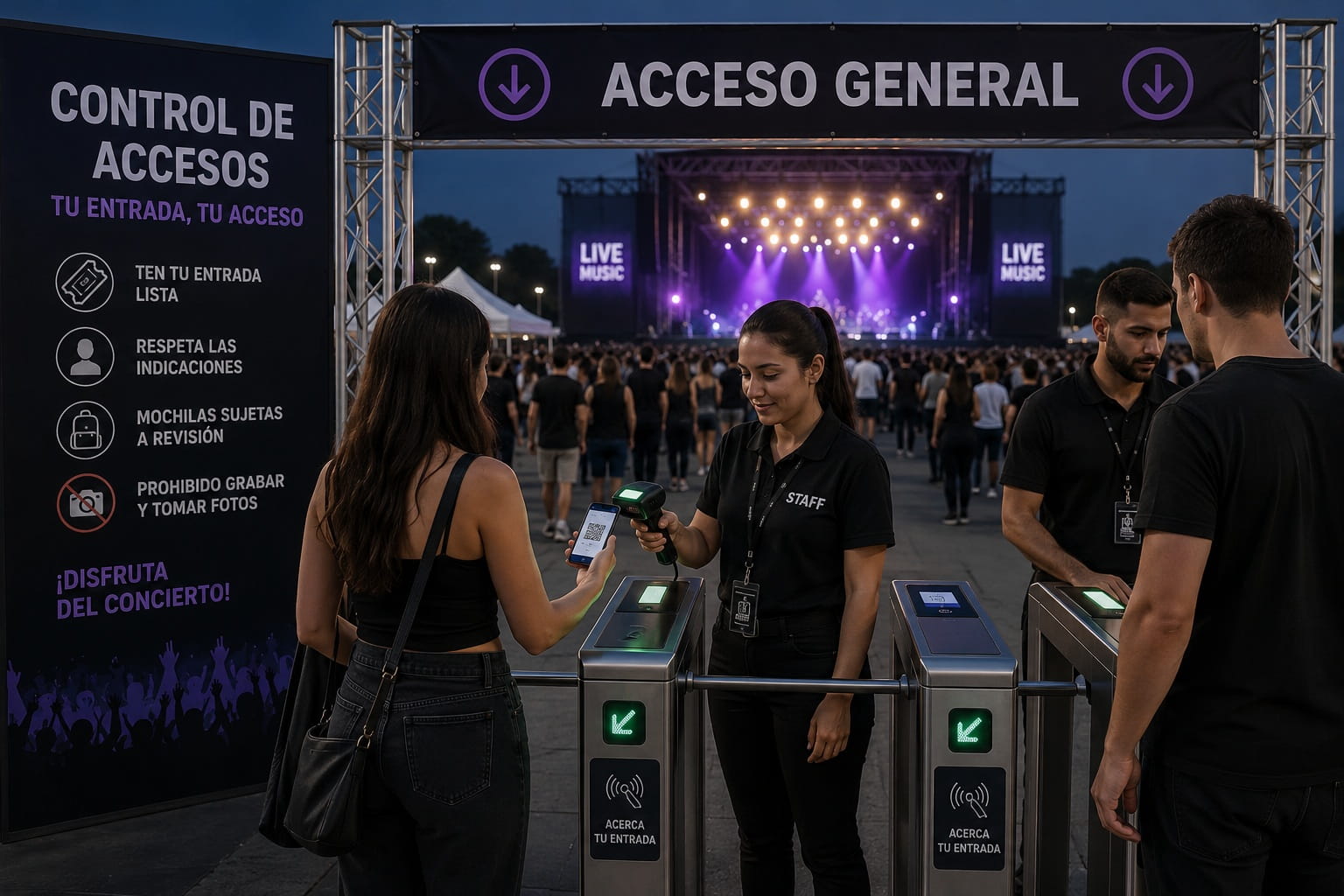
Integration with access control. If the same wristband is used for entry and payment, the attendee carries one item instead of two and the organizer manages one system instead of two.
Reporting. Confirm what data the system provides after the event: sales by zone, by product, by time slot, and total balance loaded versus consumed.
On-site technical support. Ask whether support is remote or physically present at the event. At a festival, a remote support line is of limited use when a terminal fails at peak entry time.
Topping up. Attendees add funds to their wristband either online, through the event website or app before arriving, or in person at designated top-up points inside the venue. Most events offer both. Online top-ups reduce queues on arrival, while physical points give flexibility to those who prefer to pay on site.
Refunds. If an attendee does not spend their full balance, they can usually request a refund of the remaining amount. The organizer sets the process, normally a form on the event website, along with the deadline for submitting the request and any handling fee that applies.
Refund conditions should be published before attendees load any funds. Lack of transparency around refunds is one of the most common causes of post-event complaints in the sector.
There is no universally best option. The right choice depends on the number of attendees, the number of points of sale, whether the venue has reliable connectivity and whether the system also needs to handle access control. A system that works well for a corporate conference may be unsuitable for an outdoor festival.
Yes. Most professional systems allow the same RFID or NFC wristband to serve as both the entry credential and the payment method. This simplifies the operation for the organizer and improves the experience for the attendee, who only needs to carry one item throughout the event.
Yes. Cashless wristbands are designed to resist water, sweat, and rain. You can shower with it on without any problem during the festival.
You can top up your balance in two ways: online before the event via the organizer’s website or app, or in person at the designated top-up points within the venue.
The organizer may offer a refund for any remaining balance. This is usually requested through the event website within a specific timeframe after the event ends.
Festival wristbands typically have a single-use safety clasp that can be cut with scissors. Once removed, it cannot be reused.
Yes. The cashless system stores the information on the wristband’s chip, so it works even if there is no coverage or internet connection on the premises.